

Share this
by Richard Melis on 28 Jul 2026, 17:58:19
Back in June, I published a piece about the SEMS Annual Return with an honest caveat baked into the title: there was still a lot we didn’t know. Specifically, what the return would actually ask, what format it would take and when it would need to be completed.
The DfE has now published guidance for the SEMS Annual Return. Some important gaps have been filled: we now know the format, submission route and timings. The guidance does not publish the individual questions.
Below, I have summarised what has been confirmed, what remains unclear and what responsible bodies should do next.
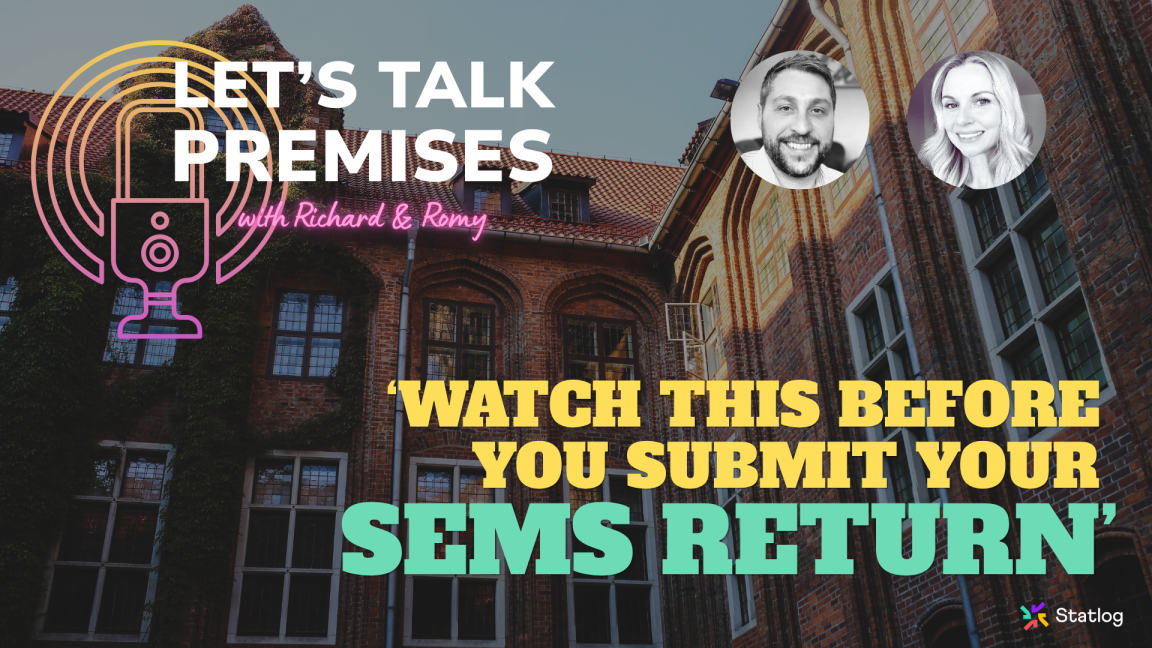
In this week’s edition of Let’s Talk Premises, Romy and I also discuss what this means in practice, including a question we have been asked more than once since the guidance appeared: what happens if you complete the return incorrectly?
We’ll come to that in the podcast. First, here is what the guidance confirms.
What’s confirmed
The return uses multiple-choice questions and does not require document uploads. It opens in the third week of September 2026 and closes in late November. It will be submitted through Manage Your Education Estate.
DfE asks responsible bodies eligible for annual capital funding to submit it, including multi-academy and single-academy trusts, local authorities, dioceses and sixth-form colleges. Individual schools do not submit the return. In dioceses containing voluntary-aided schools, the diocese will submit it and may need information from schools or governing bodies.
DfE has confirmed that the return will not affect the funding your organisation receives. Its stated purpose is to help responsible bodies understand which levels of the standards they are meeting and to give DfE information about how the standards are being followed and where support may be needed.
The return asks responsible bodies to confirm how their organisation meets the School Estate Management Standards, published in April 2025. If you haven’t read the framework, it is worth doing so before completing the return.
Where the real work sits
The return is based on the four cumulative SEMS levels. DfE says schools should begin at Level 1 and progress towards Level 3, with Level 4 available for organisations seeking advanced practice.
Some areas may already be well documented. Others may expose gaps that have previously been hidden across different systems, spreadsheets and individual schools.
Strategic estate management and governance. Level 1 expects policies, governance arrangements, an approved estate strategy and an asset management plan. Level 2 adds board awareness and the skills needed to fulfil its estate-management role. Level 3 requires regular strategic reviews to be scheduled. If those arrangements are not in place, selecting Level 3 would not reflect the published framework.
Sustainability and carbon reduction. Level 2 asks for an estate vision and climate action plan. Level 3 adds a whole-school approach to climate change that includes carbon reduction and nature recovery, along with a nominated sustainability lead. For many responsible bodies this is genuinely developing territory, and the honest self-assessment may be uncomfortable.
Estate information and digital technology. Under “Understanding and managing your land and buildings”, Level 3 asks responsible bodies to use accurate, current information and analysis, including Building Information Modelling where appropriate. The separate digital-technology requirement asks organisations to consider digital requirements as part of effective estate management. This does not mean every responsible body needs specialist BIM software: the priority is maintaining reliable, accessible information about buildings, assets, condition and compliance, which an effective premises management system can help it do.
How to approach it
Our June article covered the information you need to hold for Level 1. That remains the right starting point. If your asset register is not current, your condition surveys are out of date or your health and safety records contain gaps, those are sensible first priorities.
Beyond the information itself, a few things are worth putting in place before September.
Don’t do this in isolation. Reviewing eleven areas is not simply an estates exercise. The people involved should include whoever leads estates operationally, whoever leads finance and somebody representing governance.
Use evidence, not memory. You will not upload supporting documents, but your answers should still be based on current records. Ask what supports each answer rather than whether the organisation broadly feels as though it does something. A recorded and maintained approach gives you a firmer basis for answering than a process that exists only in people’s heads.
Be honest about where you are. The purpose is to establish where your organisation genuinely sits against the published standards, not where it would ideally like to be.
The return opens in the third week of September. There is still time to prepare properly, provided you start now.
Sources
- DfE: School estate management standards annual return
- DfE: School estate management standards
- The Autumn Return: What We Know, What We Don't
- Let's Talk Premises Podcast
🎙️ This week on Let’s Talk Premises: Romy and I are talking through what this guidance means at the sharp end — who should be involved when you complete it, what Level 3 looks like in a real school and the question everyone is quietly wondering: what happens if you overstate where you are?
Statlog...More then compliance and premises software
No Comments Yet
Let us know what you think